For Parents
Questions Parents Ask
Parents often ask themselves several questions when their child struggles with reading, such as:
Am I making too much of my child’s struggles, or is this normal development?
You may notice that reading takes more effort than expected, that homework drags on, or that progress seems inconsistent. At the same time, you may worry that you are overly concerned or impatient. Research shows that parents are often the first to notice when learning does not match effort, especially when difficulties persist over time. Voicing your concerns and advocating for your child are valid responses to what you are seeing.
Everyone says, “Just give it time.” Why doesn’t that feel right?
Well-meaning adults often encourage parents to wait. Sometimes that advice is appropriate. But many parents describe a lingering sense that something is not lining up.
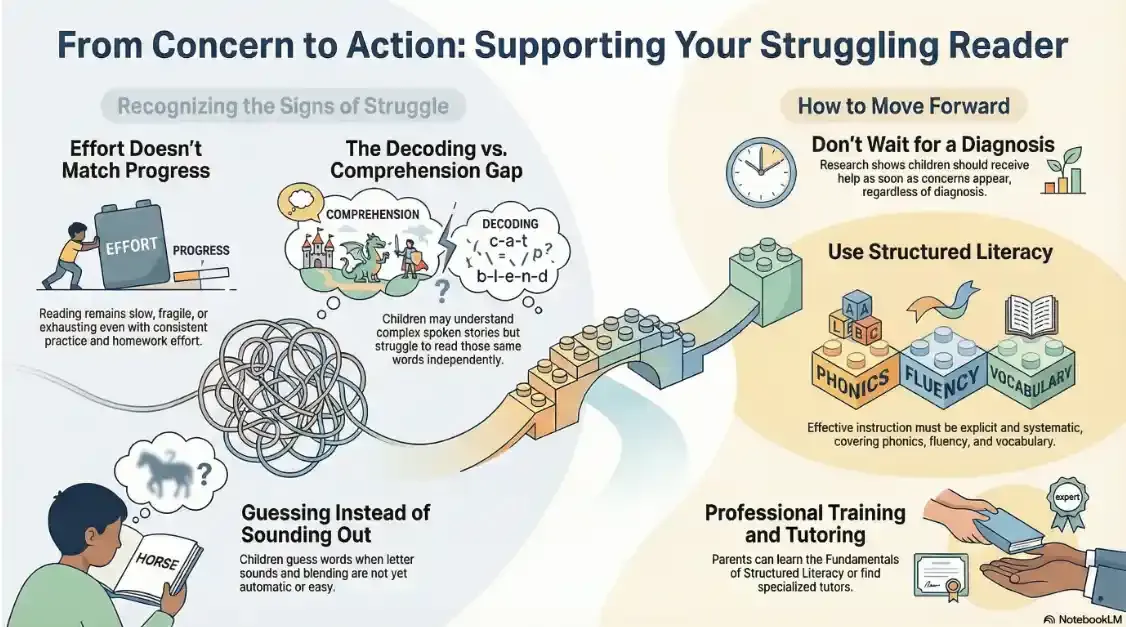
That feeling often comes from watching a child work very hard without gaining ease. Reading may remain slow, fragile, or exhausting even with practice.
Research shows that persistent reading difficulties rarely resolve on their own without targeted instruction. Wanting clearer information and evidence of reading growth before continuing to wait is reasonable.
Why does my child’s reading look so different from their siblings?
If you’ve watched more than one child learn to read, you have a built-in frame of reference. That’s why it stands out when one child’s experience feels noticeably different, even when routines, instruction, and support are similar.
Research shows that sibling comparisons can be meaningful when considered carefully. While every child is unique, children raised in the same environment often show similar patterns when learning foundational skills like reading.
Why does my child understand stories but struggle to read independently?
Your child may understand complex stories and explain ideas clearly when they are read aloud . But when reading independently, progress slows or stops.
Research distinguishes between understanding spoken language and reading printed words. A child can have strong comprehension while still struggling with decoding. This gap provides important information about the development of reading skills.
Why does my child guess at words instead of sounding them out?
Guessing often happens because decoding takes a great deal of effort. Sounding out words can feel slow, tiring, and uncertain. Often, even simple words are hard to work through one letter at a time.
In many cases, this is because letter sounds and how they work together are not yet automatic. Blending sounds to read a word or breaking a word apart to spell can feel confusing and overwhelming.
When reading requires that much effort, guessing based on the first letter or the surrounding words can feel faster and less frustrating than trying to decode every sound.
Why is spelling so much harder than reading?
For many children, spelling is harder because it requires more precise and active language skills.
When reading, a child can often recognize a word even if their understanding of the sounds is incomplete. The word is visible on the page, and context can help fill in gaps. Spelling works in the opposite direction.
To spell a word, a child must start with the spoken word, break it into individual sounds, remember those sounds in the correct order, and match each sound to the correct letters.
Do I really need a diagnosis before I can help my child?
No, and this point is important.
Research consistently shows that children should not wait for a formal diagnosis before receiving help. Reading difficulties are best addressed as soon as concerns appear.
A diagnosis may be helpful later, especially for school accommodations. But children do not need to wait for a formal diagnosis to start getting help.
What should children learn?
Learning to read is difficult and does not happen naturally. It requires explicit and systematic instruction, which is especially important for struggling readers. Learning to read involves many different skills that must be taught to your child. Instruction in phonological awareness, phonics, fluency, vocabulary, and comprehension will help your child learn to read. Young children often need explicit instruction in phonological awareness and phonics.
How can parents help?
The Fundamentals of Structured Literacy course provides a comprehensive understanding of effective reading instruction, including phonemic awareness, phonics, vocabulary development, and fluency across all skills, which support the development of a learner’s reading, writing and comprehension. This course teaches participants how to assess their learners, choose an appropriate starting point/lesson, and proceed through the sequential scope and sequence for the most individualized, efficient, and effective instruction. All lesson plans are provided to minimize prep and maximize learning. Cumulative reviews are built into the program to build fluency and automaticity.
Parents are invited to take the training. You can teach your child to read.
You can also find a tutor trained in this approach. In Prince George, tutoring is provided in the Fundamentals of Structured Literacy approach at the Learning Differences Centre. Other communities may also have tutors trained in this approach.